Solutions / Avalanche Protocol
Before the storm hits
Run yours.
Autonomous DDoS simulation. Multi-layer. Zero risk.
Avalanche Protocol stress-tests your infrastructure with realistic, adaptive DDoS scenarios , from L3 volumetric floods to L7 application strikes. Run on a digital twin. Halt instantly with Safe Switch.
22K
Average cost per minute of DDoS downtime.
>$1M
Average loss per incident for large enterprises.
89%
DDoS attacks now last under 10 minutes.
Why Avalanche
Not a stress test. A war game.
Realistic. Safe. Actionable.
Most DDoS testing tools replay a script. Avalanche thinks. It adapts intensity, distribution, and vector based on how your infrastructure responds, exactly like a real adversary would.
Realistic
An engine, not a script.
Avalanche adapts intensity, geographic distribution, and attack vector dynamically, simulating modern adversaries that shift mid-attack. No two runs are identical.
Safe
Control is always yours.
Built-in Safe Switch automatically halts simulations when risk thresholds cross. All testing runs on a digital twin of your infrastructure, your live systems stay untouched.
Actionable
Resilience, measured.
Output is not a 200-page PDF. It's a Resilience report, plus a layer-specific roadmap with prioritized interventions, DNS strategy, CDN setup, WAF rules, architecture design.
the method
Five phases.
One controlled storm.
We don't just stress the system. We engineer its limits.
05
Fortification Plan
Expert-driven, layer-specific recommendations for DNS strategy, CDN setup, WAF rules, and architecture design.
01
Tactical Alignment
We map your infrastructure landscape, define load zones, attack windows, and performance KPIs.
02
Simulated War Games
Targeted DDoS attacks executed in rising waves, with diversified payloads and behavioral noise.
03
Real-Time Monitoring
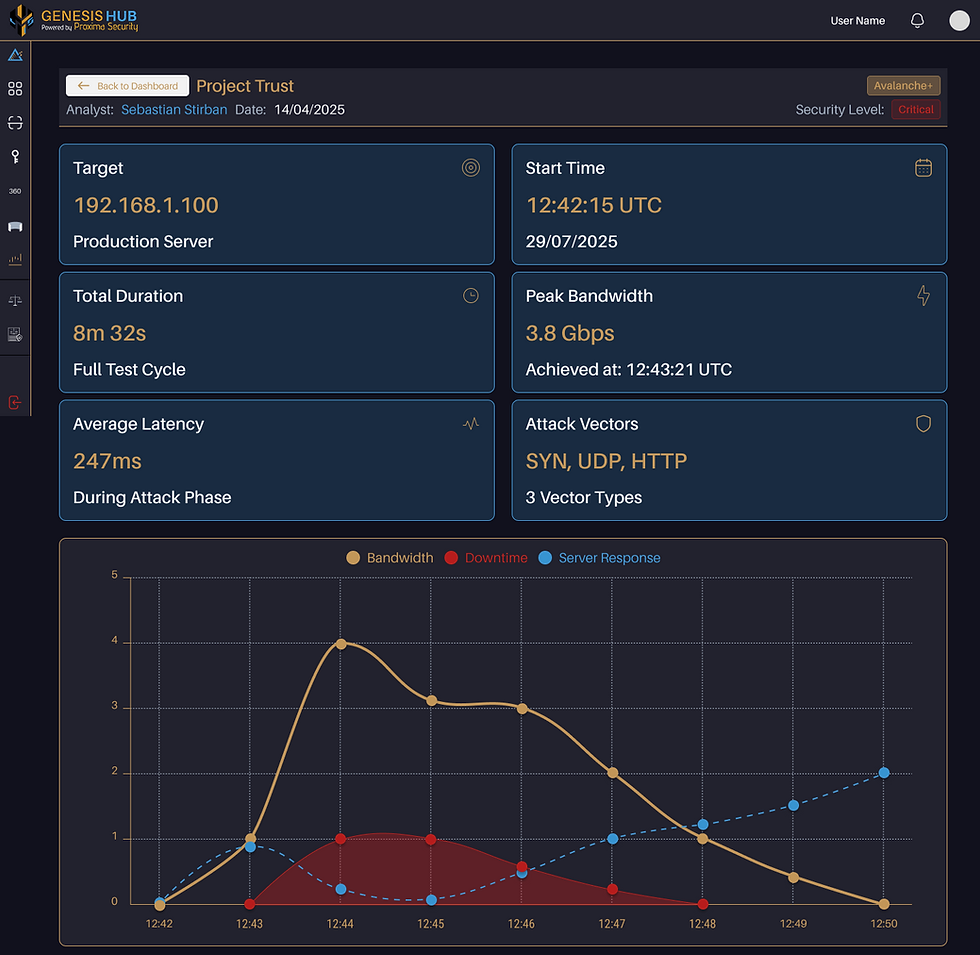
Our Matrix Dashboard captures bottlenecks, response anomalies, latency curves, and failure chains as they happen.
04
Post-Mortem Analysis
A forensic-style breakdown of your infrastructure under fire: what failed, what resisted, what needs reinforcement.
Deliverables
Resilience, executive reported and mapped.
From diagnosis to defence design.
You don't get a downtime report. You get an architectural diagnosis — what broke, why, and exactly how to fix it. The technical roadmap gives security teams what they need to act.
-
Design
A clear overview of your company
-
Layer-Specific Diagnostics
L3 / L4 / L7 breakdown of weaknesses
-
Forensic Failure Chain
Where cascading failures originated and how they spread
-
Fortification Roadmap
DNS, CDN, WAF, and architecture priorities
-
Executive + Technical Reports
For leadership and security teams
Under the Hood
Matrix · Ori · Bubi · Cornelia — the four systems that orchestrate Avalanche Protocol.
Attack Vectors
Full-spectrum attack simulation.
Volumetric. Protocol. Application. Adaptive.
Avalanche generates the full spectrum of modern DDoS scenarios, from raw bandwidth assaults to surgical application-layer strikes. All monitored in real time with custom dashboards and layer-specific diagnostics.
Adaptation
Adaptive Campaigns
Coordinated attacks that shift strategy mid-engagement. The hardest scenario to defend against.
The most realistic test.
Protocol
Stack Exploitation
SYN floods, fragmented packets, TCP anomalies. Surgical strikes against transport-layer assumptions that most infrastructures take for granted.
Logic Strikes
Application
HTTP GET/POST floods, Slowloris-style exhaustion, business logic abuse. The vectors that pass through volumetric defenses because they look like legitimate traffic.
Volume
Bandwidth Saturation
UDP floods, ICMP storms, amplification attacks. The raw volume that bypasses smaller defenses entirely. We simulate botnet-scale capacity, geographically distributed.